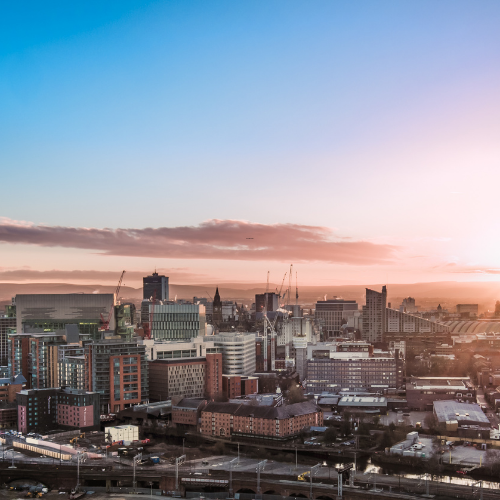
Manchester’s growth is increasingly vertical
Tall buildings are often discussed in terms of skyline impact. However, in Manchester, they also reflect a broader economic and planning trend.
The city has continued to attract major residential, hotel, student accommodation and mixed-use schemes. High-density development is being concentrated across the city centre, Salford, Great Jackson Street, Victoria North and other regeneration areas. The continued emergence of towers such as Deansgate Square, Viadux and other major schemes illustrates the extent to which Manchester is being planned and delivered as a higher-density city.
The South Tower at Deansgate Square, completed in 2018, is 201 metres tall and is one of the tallest buildings in the UK outside London. More recently, construction has started on the 76-storey Nobu tower in Manchester, reported to be more than 240 metres and set to become the UK’s tallest residential skyscraper.
This is not simply a design shift. It is a development model.
For northern cities, tall buildings can support housing delivery, the reuse of brownfield land, transport-led growth and the concentration of investment around established commercial and cultural centres. They can also help regional cities compete more effectively for institutional capital, international occupiers and long-term regeneration investment.
Policy is catching up with the pace of development
As Manchester’s skyline changes, planning policy is becoming increasingly important.
Manchester’s draft Local Plan is intended to guide development over the coming years and provide spatial policies addressing growth, inclusivity, housing, climate change, transport and other strategic issues. Within that framework, tall buildings are expected to be subject to more structured assessment.
For tall building proposals, relevant planning considerations are likely to include:
Design quality
Townscape and skyline impact
Heritage setting
Residential amenity
Daylight and sunlight
Transport and infrastructure capacity
Cumulative impact
Public benefit and regeneration value
A clearer policy framework can assist developers and decision-makers. It can help identify appropriate locations for height, provide greater consistency in decision-making and support the delivery of high-quality schemes.
However, policy clarity does not remove risk. In many cases, it changes how that risk is assessed, evidenced and challenged.
Historic England’s guidance on tall buildings notes that criteria-based policies can assist decision-makers by guiding proposals to address visual, functional, environmental and cumulative impacts. For lawyers and planning consultants, this underlines the importance of a robust evidence base at an early stage.
Tall buildings intensify legal and technical issues
The taller and denser a city becomes, the more important neighbouring interests become.
Tall buildings can unlock significant development value, but they can also increase the legal and technical risks associated with a scheme. In Manchester, where many new schemes sit close to existing commercial, residential and heritage assets, these risks can have a direct impact on design, programme and viability.
Key issues may include:
Rights of Light exposure
Neighbouring owner claims
Daylight and sunlight impacts
Heritage and townscape objections
Judicial review and planning challenge risk
Viability and funding sensitivity
Programme delay
Section 106 and public benefit arguments
Rights of Light is particularly relevant in the context of tall buildings. As development becomes denser, the potential impact on neighbouring properties increases. This can lead to negotiation, redesign, compensation exposure or, in some cases, the threat of injunctive relief.
For developers and funders, these issues are not theoretical. They can affect massing, planning strategy, financing assumptions, sales timelines and practical deliverability.
The risk is not just planning permission
Securing planning permission is a critical milestone, but it is not the end of the risk analysis.
A scheme may have planning support and still face Rights of Light issues, neighbour objections, delay exposure or challenge risk. Similarly, a tall building may be consistent with regeneration policy but still raise complex questions around heritage impact, amenity, cumulative effect or neighbouring property rights.
This distinction is particularly important for high-value urban schemes. Where project economics depend on height, density and timing, legal risk can quickly become financial risk.
For legal advisers, this means risk assessment should not be treated as a late-stage issue. It should be integrated into the development strategy from the outset, alongside planning, design, finance and stakeholder engagement.
Why this matters for Manchester and other northern cities
Manchester’s tall building boom is part of a wider story about the development of northern cities.
Regional cities are expected to deliver more homes, support economic growth, attract investment and make better use of urban land. Tall buildings can form part of that response, particularly where they are located in appropriate areas and supported by strong design, infrastructure and public realm.
However, high-density development also brings greater scrutiny. The more ambitious the scheme, the more important it becomes to manage the legal and technical issues that can affect delivery.
Manchester’s experience will therefore be closely watched by developers, planners, lawyers and investors in other cities. The same themes are likely to arise elsewhere: the need for housing, the pressure to densify, the importance of good design and the requirement to manage legal risk properly.
Managing development risk early
Manchester’s continued growth presents clear opportunities for developers, investors and advisers. However, the next phase of development will require careful risk management, particularly where tall buildings interact with neighbouring property interests.
Rights of Light remains a key consideration for high-density development. It can affect scheme design, negotiations, timetable and financial certainty. Where these risks are identified early, they can often be managed more effectively.
At Continuum Specialty, we support developers, investors and legal advisers with specialist insurance solutions for complex real estate risks, including Rights of Light.
As Manchester continues to build upwards, legal risk needs to be considered from the outset. Growth may be vertical, but deliverability still depends on a clear understanding of the legal foundations beneath each scheme.